Ripeness and yield are different questions, and we compute them separately. A May frost strips the blossom, and a bush that flowered well can still give nothing.
We do not compute numbers for this region yet: a berry needs weather for the whole season from 1 January, not a month of it as a mushroom does. The catalogue below holds regardless.
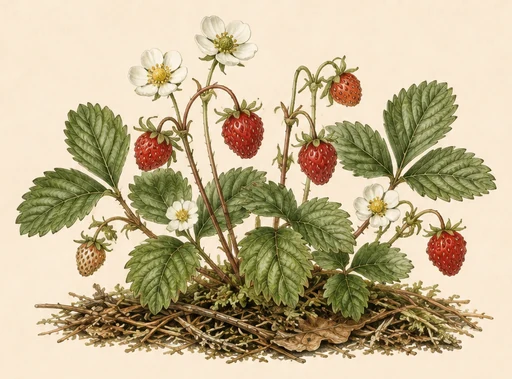
Wild strawberrywhite flower with a yellow centre, fruit small and scented
Woodland rides, clearings, railway banks, old quarries and the edges of tracks: anywhere with light and thin, well-drained soil. Under a closed canopy the leaves grow on and the plant rarely fruits, which is why a wood full of strawberry leaves can hold almost no strawberries.
Do not confuse it. Nothing poisonous is easily taken for it. Barren strawberry (Potentilla sterilis) shares the ground and looks the part until it fails to fruit, and it is harmless. The hazard at this height is a different plant: lords-and-ladies (Arum maculatum) stands a spike of red berries at ankle level on the same woodland floor, is severely irritant, and is behind many of the plant-poisoning calls involving children in Britain. It has no runners, no three-part leaf and no white flower — read all three, not any one of them. Second, and it has nothing to do with identification: across much of continental Europe the fox tapeworm Echinococcus multilocularis is established, and its eggs reach low fruit from fox droppings. Britain and Ireland are free of it; France, Germany, Switzerland, Austria, the Low Countries, Denmark, Poland and the Baltic states are not. Washing does not reliably remove the eggs and heat does. Where the parasite is present, that is a stronger reason not to eat low wild fruit straight from the plant than anything in the paragraph above.
Ripe fruit is dark red and lifts away with its calyx; unripe fruit holds on. The scent carries several paces, and a patch is usually found by smell rather than by looking. Verges are the worst place to pick: the plant likes them, and so does everything that runs along them.
Raised sphagnum bog and blanket mire in the north. Not a woodland plant: it wants open moss with water beneath it. In Britain it is confined to the Pennines, the Southern Uplands and the Highlands, and it flowers far more often than it fruits — plants are male or female, and a whole colony can be one or the other.
Do not confuse it. There is little to confuse it with: a single amber fruit on a low, unbranched stem, and no other berry of that colour on a bog. The risk here is the ground rather than the plant. Raised bog carries pools and soft edges under an unbroken surface of moss, and it is not a place to walk alone or without something to sound the ground ahead of you. In parts of the Nordic north the harvest is also regulated locally — worth checking before you fill a bucket rather than after.
The season is a matter of days: over-ripe fruit falls apart at a touch. Red fruit is unripe and stays firm; ripe fruit is orange-amber and soft enough to bruise in the hand.
Wet heath, the drier margins of raised bog, and montane heath. The bush stands taller than bilberry — to half a metre — and the ground under it is wetter.
Do not confuse it. The same two black-berried poisoners as bilberry: herb Paris (Paris quadrifolia), one berry on one stem above four leaves, and deadly nightshade (Atropa belladonna), a branched plant to waist height with glossy berries in a green ruff, dangerous in small quantities. The rule is the same: many small berries on a low woody bush against one or a few on something taller and softer. Read the whole plant rather than the colour of the fruit. From bilberry itself it differs in the fruit — longer, paler, with pale green flesh where bilberry is dark right through, and it does not stain the fingers. In the north and east of its range the plant growing beside it, marsh Labrador tea (Rhododendron tomentosum), is the source of the old story about bilberries that make you dizzy: the headache comes from a neighbour's volatile oils, not from the fruit. That plant is not part of the British flora.
Oblong, paler than bilberry, pale-fleshed and mild. On the same ground it ripens a little ahead of bilberry.
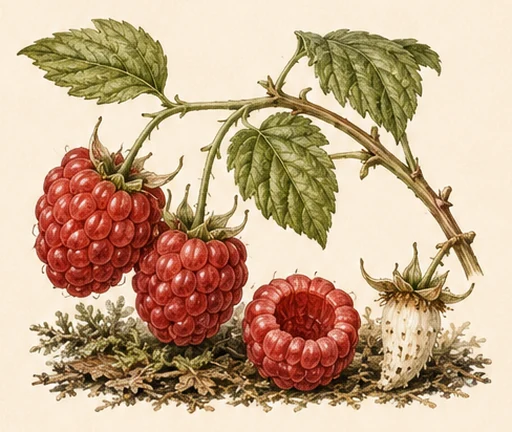
Wild raspberrylifts off a white core, cane is prickly
Clearings, felled and burnt ground, windthrow and woodland edge. It follows disturbance and light, and it goes again as the canopy closes.
Do not confuse it. Two red-berried poisoners share the same edges. Mezereon (Daphne mezereum) carries red berries sitting DIRECTLY on a bare, thornless stem with no stalk; the whole plant is poisonous and the sap blisters skin. It is scarce in Britain and frequent through central Europe. Black bryony (Dioscorea communis) is the common one in southern Britain: a vine twining through hedge and scrub, hung with strings of glossy red berries, and no prickles anywhere on it. A raspberry is not a single smooth berry at all. It is an aggregate of small drupelets that lifts off a white core and leaves that core behind on a prickly cane. A smooth round red berry on a smooth stem is something else, whatever else it may be — and that structure is a starting point, not a licence to stop looking.
Ripe fruit comes away leaving the white core on the plant; anything that needs pulling is not ready. Raspberry ground is also good tick ground — waist-high, damp and shaded — so it is worth checking yourself afterwards. Old railway land and industrial edges grow it well and are poor places to pick.
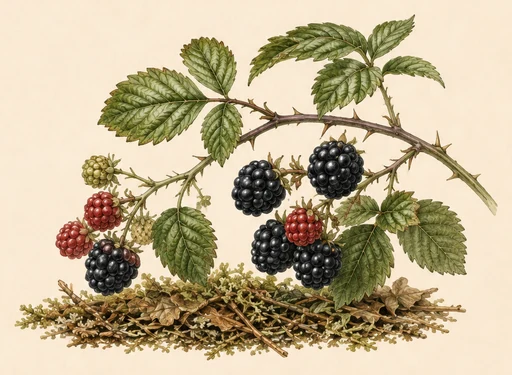
Dewberryprickly stem, black when ripe, red when not
Floodplains, ditches, riverbanks, dune slacks and damp woodland edge: the same rough ground as raspberry but wetter. On a dry felled slope raspberry takes its place.
Do not confuse it. Alder buckthorn (Frangula alnus) grows on exactly these damp margins and carries round black berries. It is poisonous and a violent purgative, and its berries sit singly or in pairs on a smooth, thornless twig. Dogwood (Cornus sanguinea) is another black-berried shrub of the same hedges and is not for eating either. A bramble fruit is an aggregate of drupelets on a prickly stem and never a single smooth sphere; unripe dewberry is red and is sometimes taken for a ripe raspberry, which is sour rather than dangerous. As always, the structure of the fruit is where you start and not where you stop. Dewberry is one of the bramble group. Most blackberrying in Britain is done on the Rubus fruticosus aggregate, which shares this ground, this fruit structure and these lookalikes.
Ripe fruit is black with a blue-grey bloom and comes away with its white core — that is what separates a bramble from a raspberry, which leaves the core behind. It ripens in waves until the first frosts.
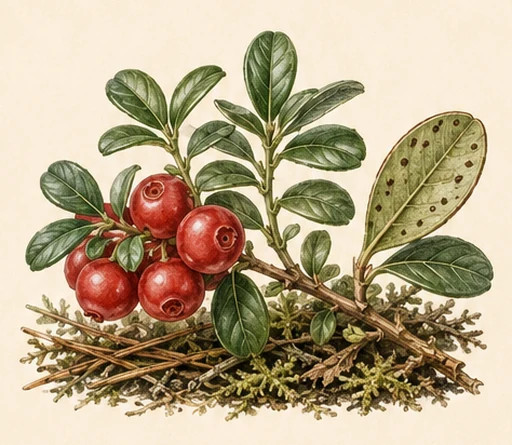
Dry pine woods, lichen heath, sandy ridges and the drier ground between bogs. It does not grow with wet feet, and that is the first thing separating it from cranberry.
Do not confuse it. Bearberry (Arctostaphylos uva-ursi) shares the ground and the red berry. It is not poisonous — dry, mealy and disappointing — but it is a different plant: bearberry leaves are plain beneath, cowberry leaves are dotted with dark glands on the underside. The serious neighbour is mezereon (Daphne mezereum), whose red berries sit directly on a bare stem with no stalk and no leaves around them; it is poisonous and the sap blisters skin. Leaf undersides and berry stalks are both worth reading, and neither settles it alone: look at the whole plant, its height and whether it is woody to the ground.
The leaves stay green through winter, so the plant can be found in any month. Fruit picked after the first frosts is sweeter and softer, and it travels badly. It is sold in shops as lingonberry.
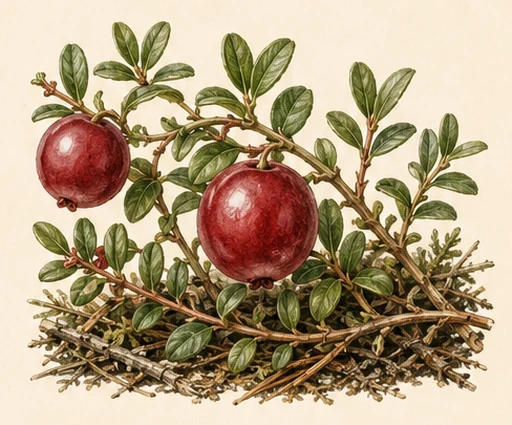
Cranberrya thread over the moss, berry larger than the leaf
Raised and blanket sphagnum bog, and nothing else. It will not be in a dry pine wood: look for moss and standing water rather than for trees.
Do not confuse it. Almost nothing resembles it: a thread-thin stem creeping over the moss, carrying a red berry that looks too large for the plant holding it. As with cloudberry, the danger is the bog itself — pools and soft ground under an unbroken surface of moss. Many British bogs are also designated sites where picking may be restricted, and the ground is fragile as well as deep.
It can be taken frosted, and it is sweeter after the first frosts. Berries that have wintered under snow and are picked in spring are softer and sweeter still, and they keep badly.
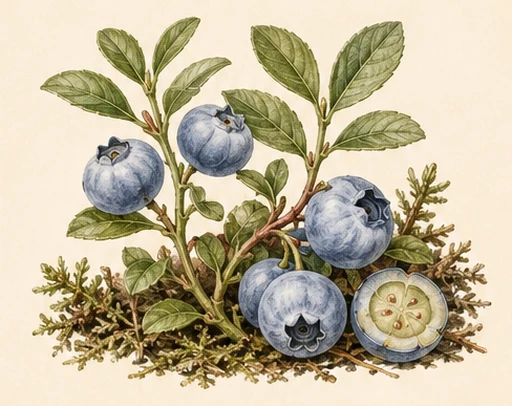
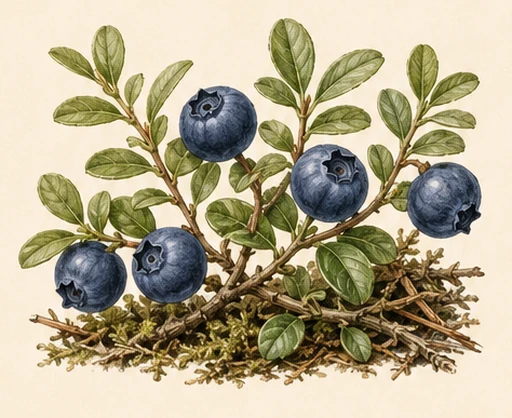
Bilberryberries all along the twig — herb Paris carries one
Acid ground under pine, oak and birch, and open moor above the tree line — usually with moss, usually in light shade. Damp, cool and acid is the pattern; it is scarce on chalk and on dry open ground.
Do not confuse it. Two poisonous plants carry black berries in the same woods, and both matter. Herb Paris (Paris quadrifolia) holds ONE black berry above a single whorl of four leaves on one unbranched stem. Deadly nightshade (Atropa belladonna) is the more dangerous and the more likely on chalk and limestone: a branched plant to waist height or more, with glossy black berries the size of a small cherry set in a green five-pointed ruff. A few of them can kill a child. Bilberry is neither: a low wiry shrub with many small berries and small leaves along every twig, each berry blue-black with a dull bloom and a tiny crown at its tip, the flesh dark purple through and through. Take none of these features on its own as proof — read the whole plant: how tall it is, whether it is woody, how the berries are arranged. Most mistakes are made by children, who see the colour from a distance and not the plant.
Ripe fruit is blue-black with a bloom and soft to the touch. It stains hands and clothes, and that is normal.
What we do not promise
Ripening dates here are computed from accumulated warmth rather than from the calendar: in a cold spring the berry ripens later, and the model follows that. But the thresholds themselves are chosen rather than measured against field records — we are confident about the order of species and still owe you the exact numbers.
And the thing that matters most: no page on this site gives you permission to eat what you found. The lookalike comparison above tells you what this berry is confused with; it does not confirm that what you are holding is that berry.
Wild berries: when they ripen and how many there will be — FungRadar