
Cranberry
Vaccinium oxycoccos
Raised and blanket sphagnum bog, and nothing else. It will not be in a dry pine wood: look for moss and standing water rather than for trees.
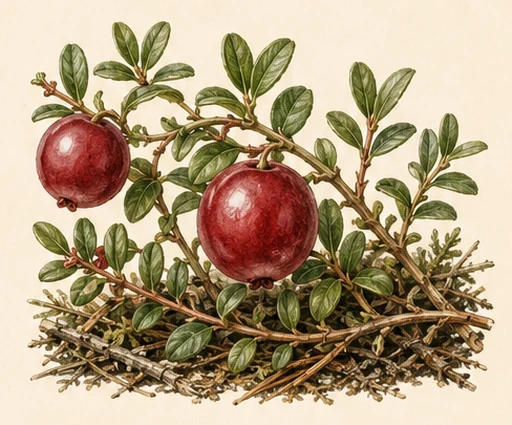
It can be taken frosted, and it is sweeter after the first frosts. Berries that have wintered under snow and are picked in spring are softer and sweeter still, and they keep badly.
Where people are picking now
the best place in the region — not an average over the region. Regions are ranked by today's number.
The fraction beside the stage says how many measurement points out of how many the region was computed from. “1/22” means the weather history was long enough at one place out of twenty-two: the number describes that place, not the whole region.
- Emilia-Romagnaripe100
- Friuli-Venezia Giuliaripe100
- Goriškaripe2/4100
- Lazioripe100
- Lombardiaripe10/47100
- Toscanaripe100
- Trentino-Alto Adigeripe100
- Umbriaripe100
- Valle d'Aostaripe100
- Venetoripe100
- Ticinoripe100
- Liguriaripening77
The forecast is computed for 23 regions out of 583. The rest are not listed — that is "not computed", not "no berries".
Map
The field is built from a network of measurement points, the way a meteorologist draws a rainfall map from a network of stations: the value is computed at each point and interpolated between them. A cell is about 250 km² across, which is the resolution our weather data comes at, and we do not draw it finer: that would be invented precision. Only the “how much” goes into the colour, not the stage: “a little, ripe” and “plenty, still green” look the same on the map — read the stage on the card. Blank cells are where the season history was too short to compute, not where the berry is absent.
All berries, compared for today
Your comment
No sign-up. A question, a correction, an observation — all welcome.