
Wild strawberry
Fragaria vesca
Woodland rides, clearings, railway banks, old quarries and the edges of tracks: anywhere with light and thin, well-drained soil. Under a closed canopy the leaves grow on and the plant rarely fruits, which is why a wood full of strawberry leaves can hold almost no strawberries.
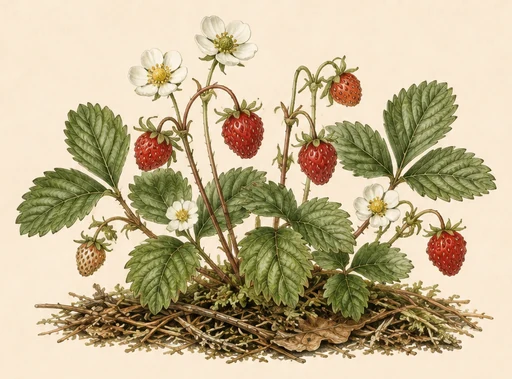
Ripe fruit is dark red and lifts away with its calyx; unripe fruit holds on. The scent carries several paces, and a patch is usually found by smell rather than by looking. Verges are the worst place to pick: the plant likes them, and so does everything that runs along them.
Where people are picking now
the best place in the region — not an average over the region. Regions are ranked by today's number.
The fraction beside the stage says how many measurement points out of how many the region was computed from. “1/22” means the weather history was long enough at one place out of twenty-two: the number describes that place, not the whole region.
- Trentino-Alto Adigeripe100
- Abruzzodropping0
- Calabriadropping0
- Campaniadropping0
- Emilia-Romagnadropping0
- Friuli-Venezia Giuliadropping0
- Goriškadropping2/40
- Laziodropping0
- Liguriadropping0
- Lombardiadropping10/470
- Piemonteunripe2/490
- Toscanadropping0
The forecast is computed for 17 regions out of 583. The rest are not listed — that is "not computed", not "no berries".
Map
The field is built from a network of measurement points, the way a meteorologist draws a rainfall map from a network of stations: the value is computed at each point and interpolated between them. A cell is about 250 km² across, which is the resolution our weather data comes at, and we do not draw it finer: that would be invented precision. Only the “how much” goes into the colour, not the stage: “a little, ripe” and “plenty, still green” look the same on the map — read the stage on the card. Blank cells are where the season history was too short to compute, not where the berry is absent.
All berries, compared for today
Your comment
No sign-up. A question, a correction, an observation — all welcome.