
Panthercap in Mogilev Region: the week ahead
Amanita pantherina
The map below is built from the measurement network. A 2.5 km grid with a per-species layer is computed for one region so far.
Flush phase
- Quiet
- Starting
- Building
- Peak
- Fading
Updated 18 September 2026, 11:37 BST
7 days
Index, day by day
Week's best 42 — on Thursdayaverage 37by the weekend steady
Conditions are poor: even the week's best day only reaches «slow».
- Today4018 Sept
- Sat3619 Sept
- Sun3420 Sept
- Mon3421 Sept
- Tue3422 Sept
- Wed3823 Sept
- Thu4224 Sept
Map
Where to look: panthercap
A field over the measurement network. The colour here is for the leading species at each point, not for this one; a per-species layer is computed for one region so far.
Panthercap in Mogilev Region: where to look
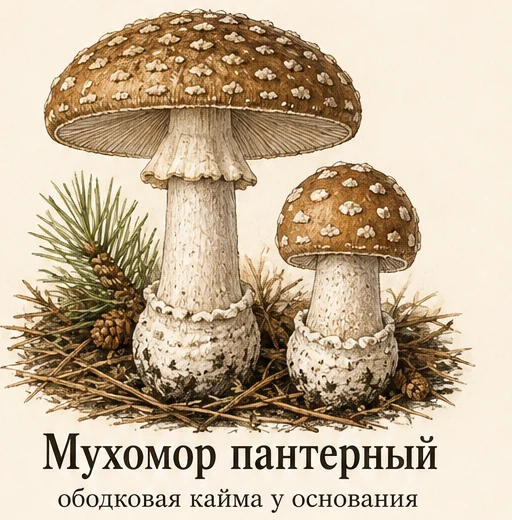
Panthercap: the species in brief
How to tell it
The cap is grey-brown to dark brown with small white patches. The gills are white. There is usually a ring on the stem and a bulbous base with a distinct rim or collar. The plain brown cap makes it less obvious than Fly Agaric.
Where it grows
Mostly in broadleaved and mixed woodland, often on light or sandy soils.
This is a note about the species, not about what is in your basket. Full card with lookalikes →
What else is out here now
The other species in this region, by today's index.
Panthercap in neighbouring regions
A regional boundary means nothing to a mushroom, and the next region is sometimes closer than the far side of your own. The index is for today.