
ParasolMacrolepiota procera
Traditionally collected in: Italy, France, Poland, Germany, Russia and the United Kingdom
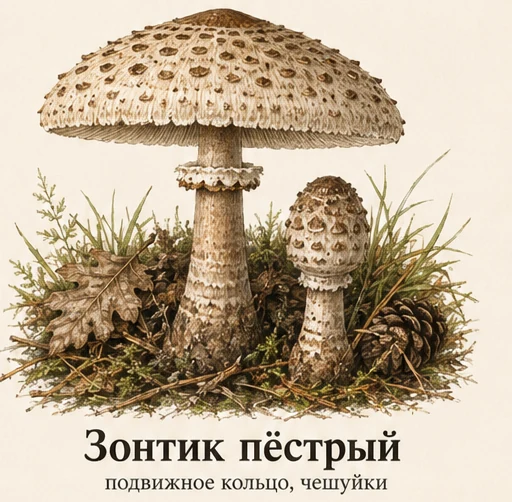
Description
A tall mushroom with a broad cap covered in brown scales on a pale background. The stem has a snakeskin-like pattern and a thick ring that is often movable. Mature specimens are large and distinctive, but no single feature should be used on its own.
Where it grows
On woodland edges, in clearings, parks, pasture and grassy commons.
Mainly from summer into autumn after wet weather.
«Parasol — or something like it?»
If the description above leaves you unsure, do not guess from memory and do not compare by eye with a picture off the internet. Our photo identifier shows several likely candidates with percentages, and names the dangerous lookalikes if there are any — rather than one confident answer.
In detail
Season
Fruits from mid July to mid October.
What to do with it
This species may not be picked (see «Caution» below), so storing and cooking do not belong here. If you find one: photograph it where it stands, do not cut or dig it up, and remember the spot for your own records — the mycelium fruits there year after year.
Take care
Edible when correctly identified, but young unopened fruitbodies are much harder to identify than mature ones and may be confused with dangerous Amanitas or other parasol-like mushrooms. Beginners should leave immature specimens.
This species is easily confused with Young Amanita, Amanita pantherina — see the lookalikes section below. Pick only what has been confirmed by someone who knows the fungi of your area.
Nothing on this page is an expert opinion, and nothing here confirms that the mushroom you found is edible. Photo identification in this service is a probabilistic hint, not permission to pick or to eat.
Lookalikes
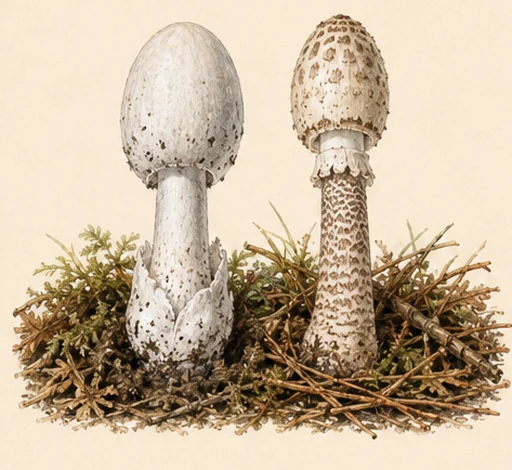
The genus holds Europe's deadliest mushrooms, and a young one still wrapped in its veil gives away almost nothing about which species it is.
A photograph cannot settle this, and at the young stage nothing settles it from a distance. The marks that separate a Parasol from an Amanita, a ring that moves and a base with no volva, are made with the hands on a mushroom lifted whole out of the ground, and at the drumstick stage the ring is not yet free and the base is still buried.
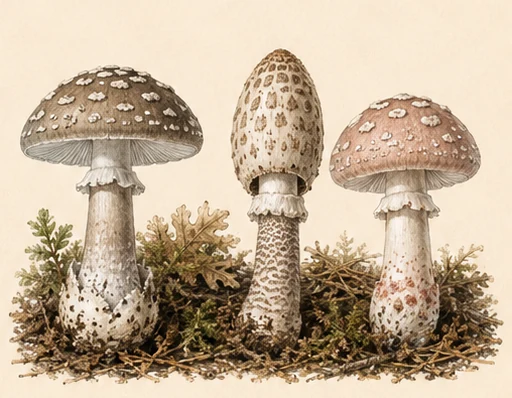
Highly poisonous and potentially fatal, with severe neurological effects.
A photograph cannot settle this pair. Whether the ring moves is a test made with a finger, not a state an image records. The stem base and its rim are under the soil unless the mushroom has been dug up, and young unopened specimens of both are pale drumsticks.
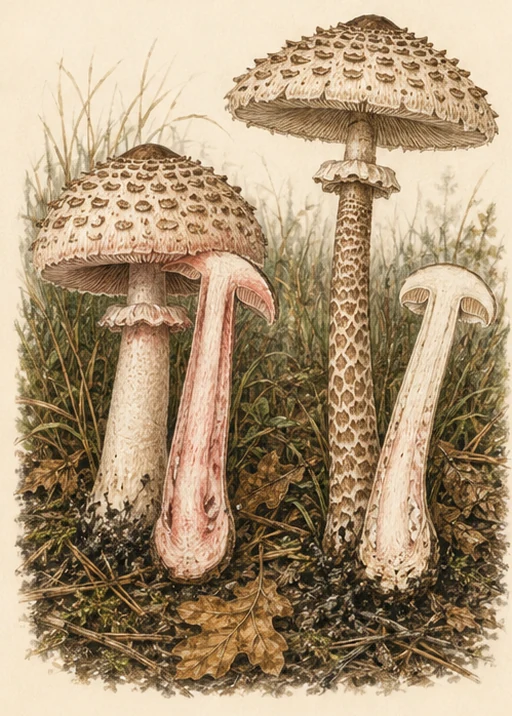
Far less dangerous than the Amanitas, but it gives some people a marked stomach upset.
- ·Cut the flesh and the stem: Shaggy Parasol reddens and then browns within a minute, most strongly at the stem base, while a Parasol's flesh does not change colour.
- ·The stem of Shaggy Parasol is smooth and pale, without the brown snakeskin banding that runs up a Parasol's stem.
- ·Shaggy Parasol is shorter and stouter with a broader bulb, and it favours rich ground such as garden borders, compost heaps, nettle beds and conifer plantations, whereas Parasol belongs to open grassland and woodland edges.
- ·In southern Europe and increasingly around the Mediterranean the same shape is taken by the Green-spored Parasol (Chlorophyllum molybdites), a serious cause of poisoning, whose spore print is green; neither Parasol nor Shaggy Parasol has green spores.
Check whether this one is out near you
The foraging forecast changes daily — with rainfall, temperature and the phase of the flush, rather than «it ought to be the season».
Your comment
No sign-up. A question, a correction, an observation — all welcome.
Updated from the FungRadar species reference · not a specialist's determination