
Black MorelMorchella elata
- Formerly:
- Morchella conica
Traditionally collected in: France, Italy, Spain, Germany, Russia and Poland

Description
A dark, conical or elongated head with deep pits and ridges, attached to a pale hollow stem. The whole fruitbody is hollow from top to bottom.
Where it grows
Often on disturbed ground, including woodland edges, old burn sites, clearings, orchards, riverbanks and landscaped areas with wood chip.
Spring. Fruiting is strongly influenced by soil temperature as well as moisture.
«Black Morel — or something like it?»
If the description above leaves you unsure, do not guess from memory and do not compare by eye with a picture off the internet. Our photo identifier shows several likely candidates with percentages, and names the dangerous lookalikes if there are any — rather than one confident answer.
In detail
Season
Fruits from mid April to early June.
What to do with it
This species may not be picked (see «Caution» below), so storing and cooking do not belong here. If you find one: photograph it where it stands, do not cut or dig it up, and remember the spot for your own records — the mycelium fruits there year after year.
Take care
Morels must be cooked thoroughly and should never be eaten raw or undercooked. False morels can be dangerous and may appear at the same time of year. Cut a specimen lengthways as one useful check: true morels are hollow inside, while false morels usually have a more irregular, chambered interior. Do not rely on this feature alone.
Nothing on this page is an expert opinion, and nothing here confirms that the mushroom you found is edible. Photo identification in this service is a probabilistic hint, not permission to pick or to eat.
Lookalikes
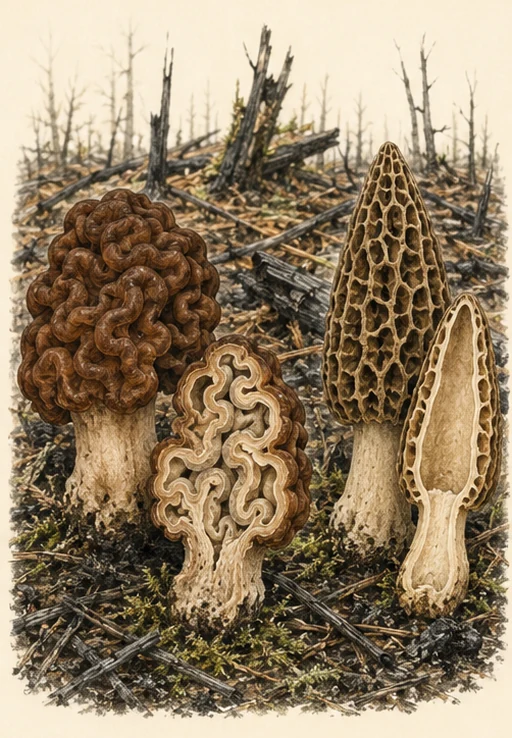
Poisonous: it contains gyromitrin, which cooking does not reliably remove and whose effects build up over repeated meals.
- ·Cut the fruitbody from top to bottom: a true morel is hollow from the tip of the head to the base of the stem, one continuous space, while False Morel is filled with folded, chambered tissue.
- ·The head of a morel is pitted like a honeycomb, with ridges enclosing sunken pits; False Morel is a brain-like mass of irregular folds with no pits at all.
- ·The head of a morel is joined to the stem along its lower edge, whereas the folds of False Morel hang free and are attached only near the top.
- ·The two fruit in the same spring weeks on the same disturbed, sandy ground under conifers, so each fruitbody is cut and looked at rather than the group being judged as a whole.
Check whether this one is out near you
The foraging forecast changes daily — with rainfall, temperature and the phase of the flush, rather than «it ought to be the season».
Your comment
No sign-up. A question, a correction, an observation — all welcome.
Updated from the FungRadar species reference · not a specialist's determination