
Field MushroomAgaricus campestris
Traditionally collected in: the United Kingdom, Ireland, France, Germany, Italy, Spain, Russia and Poland
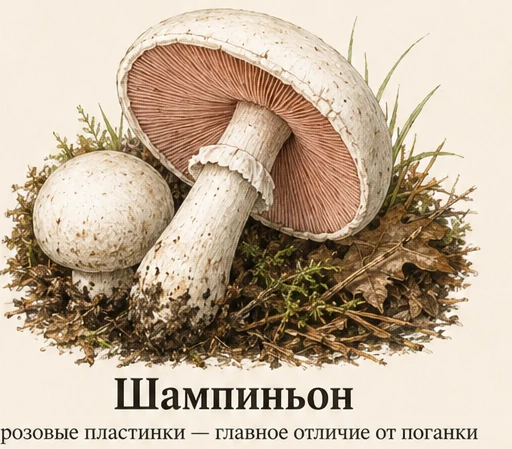
Description
A white to cream cap with pink gills when young, darkening with age. The stem has a small ring, which may become faint or disappear on older specimens.
Where it grows
On meadows, pasture, lawns, downland and field margins, especially on nutrient-rich grassland.
From late spring into autumn, often in flushes after warm rain.
«Field Mushroom — or something like it?»
If the description above leaves you unsure, do not guess from memory and do not compare by eye with a picture off the internet. Our photo identifier shows several likely candidates with percentages, and names the dangerous lookalikes if there are any — rather than one confident answer.
In detail
Season
Fruits from mid May to mid October.
What to do with it
This species may not be picked (see «Caution» below), so storing and cooking do not belong here. If you find one: photograph it where it stands, do not cut or dig it up, and remember the spot for your own records — the mycelium fruits there year after year.
Take care
A good edible species, but Agaricus identification deserves care. Young Field Mushrooms have pink gills that darken to chocolate brown with age. Deadly Amanitas keep white gills and may have a cup or swollen structure at the base of the stem. Yellow Stainer can also look similar and may turn bright yellow when bruised, often with a chemical or inky smell. Never rely on gill colour alone, and do not eat a specimen unless the whole mushroom has been checked.
This species is easily confused with Deathcap, Destroying Angel — see the lookalikes section below. Pick only what has been confirmed by someone who knows the fungi of your area.
Nothing on this page is an expert opinion, and nothing here confirms that the mushroom you found is edible. Photo identification in this service is a probabilistic hint, not permission to pick or to eat.
Lookalikes
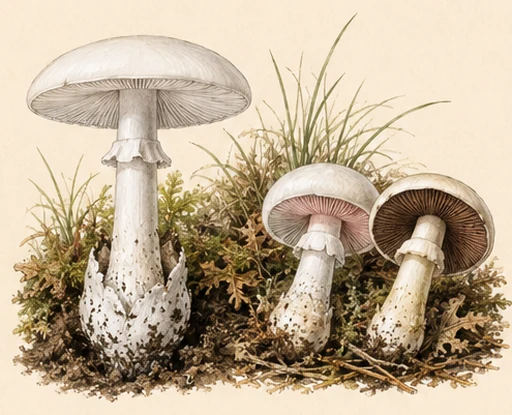
Deadly poisonous, and the cause of most fatal mushroom poisonings in Europe.
A photograph cannot settle this pair, and it is the pair on which mushroom identification applications have been shown to fail, with people hospitalised as a result. The sac at the stem base is under the soil and missing from almost every picture, young gills of both can look pale in an image, and the greenish tint of a Death Cap is often not there at all.
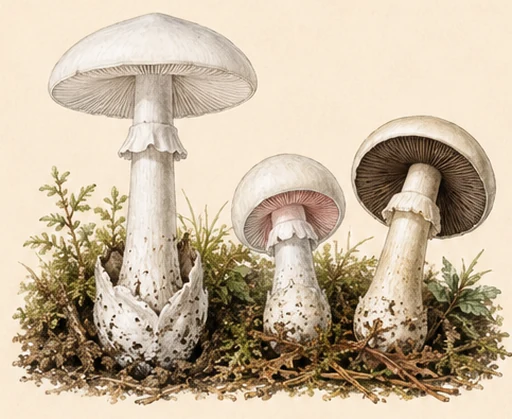
Deadly poisonous, with the same class of toxins as the Death Cap.
A photograph cannot settle this pair. The determination rests on the volva, and in the great majority of photographs the volva is below ground, often still below ground in the mushroom itself. A white mushroom in grass, photographed from above, is not identifiable, and treating it as identifiable is how this species gets eaten.
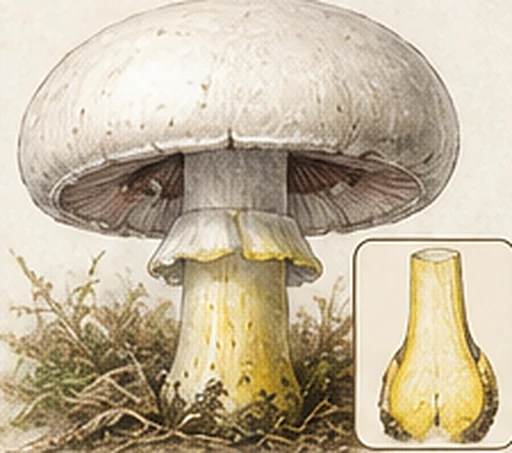
Poisonous, causing cramps, nausea, vomiting and diarrhoea, and among the mushrooms most often eaten by mistake in Europe.
- ·Scratch or cut the very base of the stem: Yellow Stainer flushes bright chrome-yellow there within seconds and the yellow then dulls to brown, while a Field Mushroom flushes pink or slowly goes dingy brownish.
- ·Crush a piece of the stem base and smell it: Yellow Stainer smells of ink, phenol or a chemist's shop, and a Field Mushroom smells of mushroom.
- ·The cap of Yellow Stainer is chalky white with a greyish or brownish centre and frequently squares off at the margin into an angular outline; a Field Mushroom is rounded and evenly white to cream.
- ·Gills of Yellow Stainer are greyish pink before turning chocolate, against the clearer bright pink of a young Field Mushroom, so gill colour is a weak mark here and should not be used on its own.
Check whether this one is out near you
The foraging forecast changes daily — with rainfall, temperature and the phase of the flush, rather than «it ought to be the season».
Your comment
No sign-up. A question, a correction, an observation — all welcome.
Updated from the FungRadar species reference · not a specialist's determination