
Fairy Ring ChampignonMarasmius oreades
Traditionally collected in: the United Kingdom, France, Germany, Russia and Poland
Description
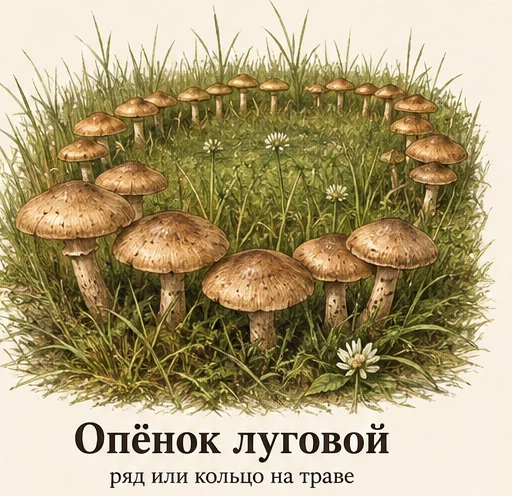
A small buff to tan mushroom with a low central bump. The stem is thin, tough and flexible. It often grows in rings or arcs in grass.
Where it grows
On lawns, meadows, pasture, playing fields and other short grass. Widespread across Europe.
From late spring into autumn, often appearing quickly after rain. Dried fruitbodies can sometimes revive after wet weather.
«Fairy Ring Champignon — or something like it?»
If the description above leaves you unsure, do not guess from memory and do not compare by eye with a picture off the internet. Our photo identifier shows several likely candidates with percentages, and names the dangerous lookalikes if there are any — rather than one confident answer.
In detail
Season
Fruits from mid May to mid October.
What to do with it
This species may not be picked (see «Caution» below), so storing and cooking do not belong here. If you find one: photograph it where it stands, do not cut or dig it up, and remember the spot for your own records — the mycelium fruits there year after year.
Take care
Edible when correctly identified. It can grow in the same grassland as poisonous white funnel mushrooms. The gills of Fairy Ring Champignon are pale and widely spaced; poisonous funnels usually have more crowded gills running down the stem. Do not rely on one feature alone.
Nothing on this page is an expert opinion, and nothing here confirms that the mushroom you found is edible. Photo identification in this service is a probabilistic hint, not permission to pick or to eat.
Lookalikes
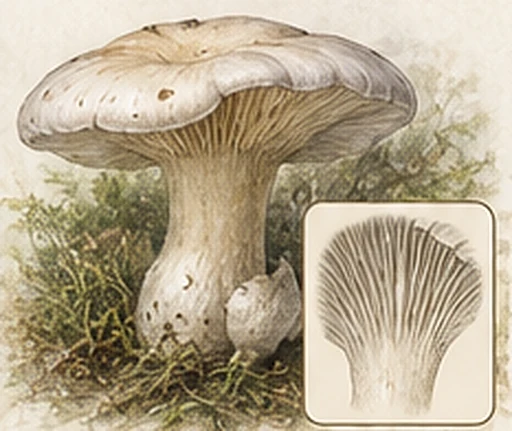
Poisonous: muscarine again, with sweating, streaming eyes, vomiting and a slowed pulse.
- ·Ivory Funnel grows on the same lawns, verges, dunes and pastures as Fairy Ring Champignon and makes rings of its own, so a ring in grass is a mark of neither.
- ·The cap is chalky white with a faint bloom and often shows concentric watery bands as it dries; Fairy Ring Champignon is tan to buff, unzoned, and dries paler from the centre outwards.
- ·The gills of Ivory Funnel are white, crowded and run down the stem; those of Fairy Ring Champignon are pale, thick, well spaced and do not run down.
- ·Fairy Ring Champignon has a wiry stem that twists without breaking; Ivory Funnel snaps.
Poisonous: it contains muscarine, and sweating, salivation and vomiting begin within the hour.
- ·Turn the mushroom over: Fairy Ring Champignon has pale, thick, widely spaced gills that are free of the stem or barely touch it, while the white funnels have crowded gills running down the stem.
- ·The stem of Fairy Ring Champignon is tough and wiry and can be twisted without snapping; the funnel's stem is brittle and breaks.
- ·Crushed flesh of Fairy Ring Champignon smells faintly of almonds or new-mown hay; the funnels smell of raw meal.
- ·Both make rings in the same short grass and can fruit in the same ring, so they are picked and examined one at a time rather than by the handful.
Check whether this one is out near you
The foraging forecast changes daily — with rainfall, temperature and the phase of the flush, rather than «it ought to be the season».
Your comment
No sign-up. A question, a correction, an observation — all welcome.
Updated from the FungRadar species reference · not a specialist's determination