
Hen of the WoodsGrifola frondosa
Traditionally collected in: Italy, France and Russia
Description
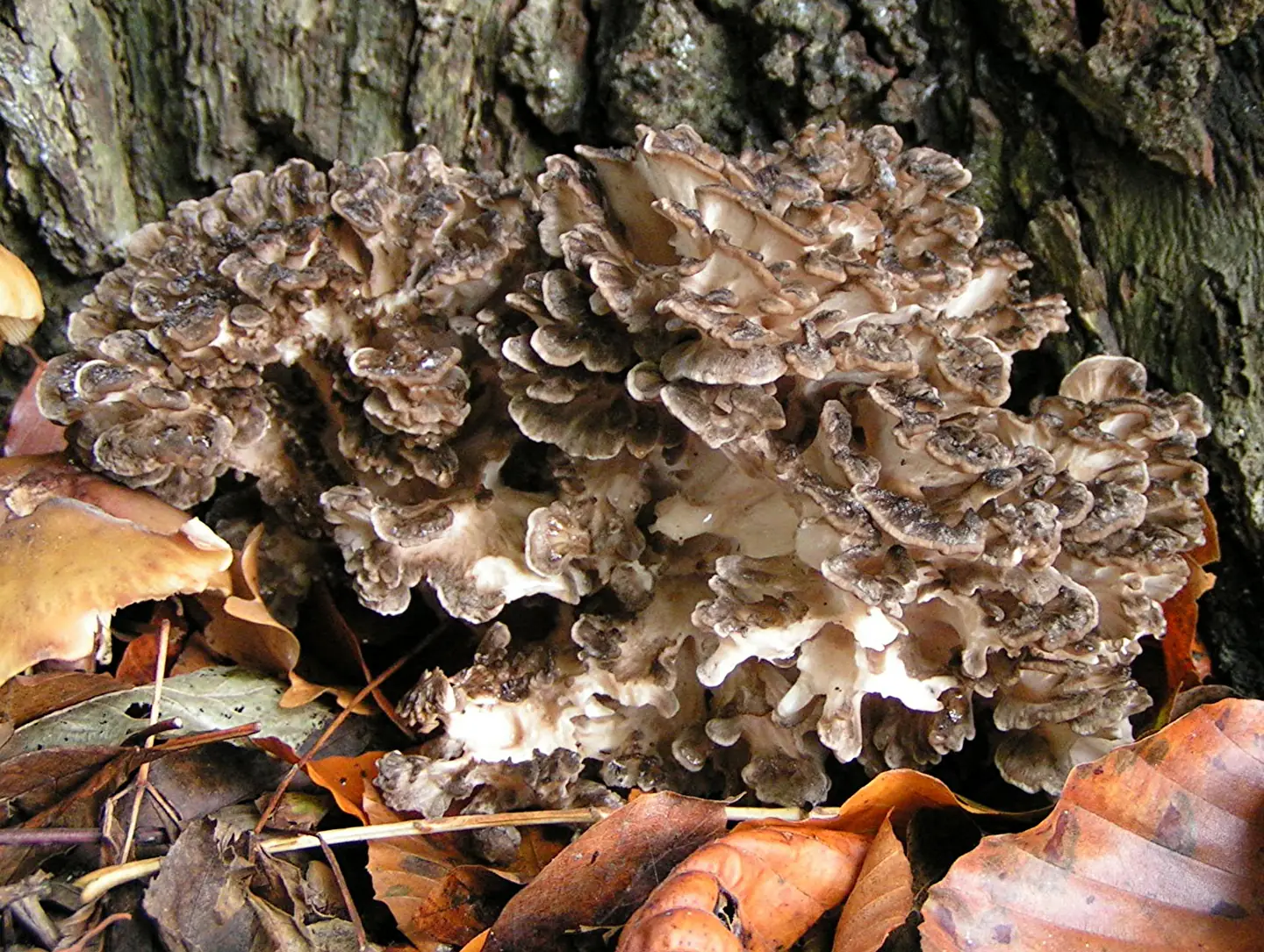
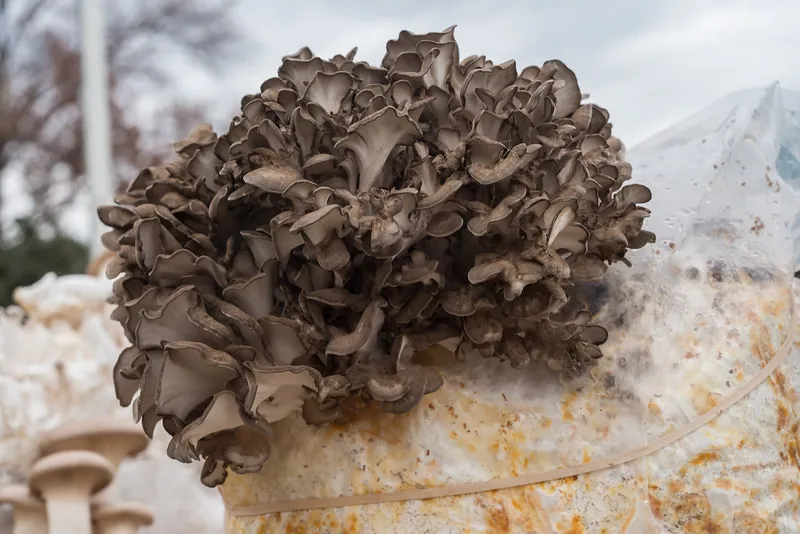
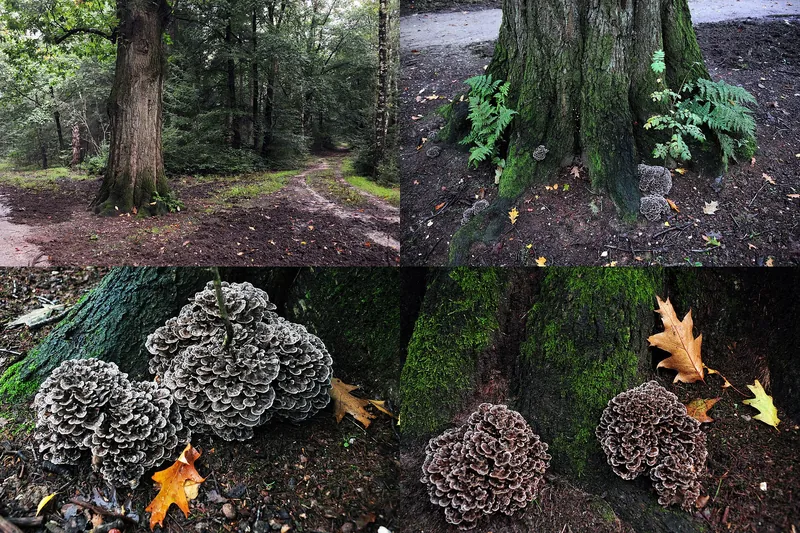
A large rosette made of many overlapping grey-brown fronds growing from one branched base. The underside has tiny white pores rather than gills.
Where it grows
Usually at the base of old broadleaved trees, especially oak, or on old stumps. The same tree may produce fruitbodies again in later years.
Mostly from late summer into autumn.
«Hen of the Woods — or something like it?»
If the description above leaves you unsure, do not guess from memory and do not compare by eye with a picture off the internet. Our photo identifier shows several likely candidates with percentages, and names the dangerous lookalikes if there are any — rather than one confident answer.
Season
Fruits from early August to mid October.
What to do with it
This species may not be picked (see «Caution» below), so storing and cooking do not belong here. If you find one: photograph it where it stands, do not cut or dig it up, and remember the spot for your own records — the mycelium fruits there year after year.
Take care
Edible and highly regarded when young. It has a distinctive form, but no wild mushroom should be treated as impossible to confuse. Confirm the identification before eating and check local protection rules.
Nothing on this page is an expert opinion, and nothing here confirms that the mushroom you found is edible. Photo identification in this service is a probabilistic hint, not permission to pick or to eat.
Lookalikes
Edible only when very young and after boiling, and even then it upsets the stomach of some people. Mature fruitbodies are tough and bitter.
- ·Press or scratch the pores underneath: those of the Giant Polypore darken quickly to brown and then black, those of Hen of the Woods do not darken.
- ·Thickness of the lobes: the caps of the Giant Polypore are fleshy, a centimetre or two and more; the leaf-like tongues of Hen of the Woods are a few millimetres thin.
- ·Number and size of caps: the Giant Polypore has few, each ten to fifty centimetres across; Hen of the Woods has up to a hundred small tongues on a much-branched common stem.
- ·Size of the whole rosette: the Giant Polypore reaches fifty to a hundred and fifty centimetres and tens of kilogrammes, Hen of the Woods usually twenty to forty centimetres.
Edible and rated no lower than Hen of the Woods. The species is uncommon and red-listed in Russia and in a number of European regions.
- ·How the stem meets the cap: exactly in the centre in the Umbrella Polypore, so that the cap sits on it like a parasol; to one side of the lobe in Hen of the Woods.
- ·Shape of the caps: round, even and nearly all of a size in the Umbrella Polypore; tongue-shaped, wavy and of differing sizes in Hen of the Woods.
- ·Colour: the caps of the Umbrella Polypore are pale grey or brownish-grey and plain; those of Hen of the Woods are grey-brown with radial streaking and a darker edge.
Edible and good. It is red-listed in Russia, so it is more often photographed than cut.
- ·The Wood Cauliflower is built of flat curly ribbons, like a head of sea kale; it has no caps at all.
- ·Underneath it has neither tubes nor pores: it carries its spores on the smooth surface of the ribbons, whereas the whole underside of the lobes of Hen of the Woods is porous.
- ·Host tree: the Wood Cauliflower grows at the foot of pine and other conifers, Hen of the Woods at broadleaved trees, most often oak.
- ·Colour: the Wood Cauliflower is white or cream-yellow throughout; the upper side of the lobes of Hen of the Woods is grey-brown.
Check whether this one is out near you
The foraging forecast changes daily — with rainfall, temperature and the phase of the flush, rather than «it ought to be the season».
Your comment
No sign-up. A question, a correction, an observation — all welcome.
Updated from the FungRadar species reference · not a specialist's determination