
Field BlewitCollybia personata
- Formerly:
- Lepista personata, Lepista saeva
Traditionally collected in: the United Kingdom, France, Italy and Russia
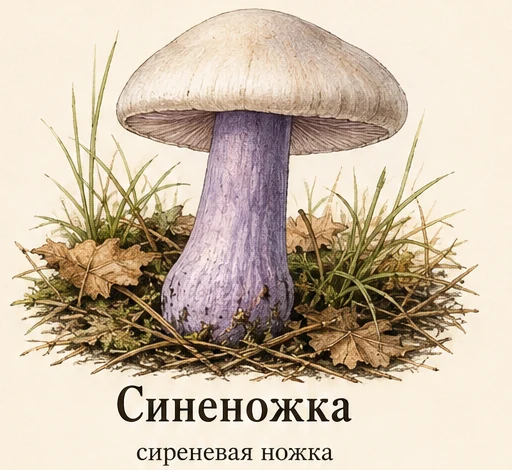
Description
A pale buff to greyish cap on a thick lilac or violet stem. The contrast between the pale cap and coloured stem is characteristic, but should not be used as the only identification feature.
Where it grows
On pasture, downland, grassy commons, garden edges and other open, nutrient-rich ground.
Mostly in late autumn and early winter, often after cool, wet weather.
«Field Blewit — or something like it?»
If the description above leaves you unsure, do not guess from memory and do not compare by eye with a picture off the internet. Our photo identifier shows several likely candidates with percentages, and names the dangerous lookalikes if there are any — rather than one confident answer.
In detail
Season
Fruits from early September to mid December.
What to do with it
This species may not be picked (see «Caution» below), so storing and cooking do not belong here. If you find one: photograph it where it stands, do not cut or dig it up, and remember the spot for your own records — the mycelium fruits there year after year.
Take care
Edible when correctly identified and thoroughly cooked. Do not eat it raw. Because it often grows in pasture and other open ground, avoid visibly contaminated, heavily treated or roadside sites.
Nothing on this page is an expert opinion, and nothing here confirms that the mushroom you found is edible. Photo identification in this service is a probabilistic hint, not permission to pick or to eat.
Lookalikes
Poisonous. Within thirty minutes to two hours it gives vomiting, diarrhoea and headache that can last two days. It is held to cause about a tenth of all mushroom poisonings in Europe.
A photograph cannot settle this pair. The lilac stem, which is the main separator, fades to dirty white in old or dried-out Field Blewits, and at that point the two look alike in a picture. The two marks that remain reliable, the smell and the colour of the spore print, do not photograph at all.
Edible after boiling, like Field Blewit itself, and upsetting the stomach if eaten raw. Confusing the two is not dangerous.
- ·What exactly is violet: in Wood Blewit the cap, the gills and the stem are all lilac; in Field Blewit only the stem is, and the cap is grey-cream to yellowish-brown.
- ·Habitat: Field Blewit grows in open meadows, grazing land, pasture and along wood edges, often in rings; Wood Blewit grows in woodland litter and on compost and leaf heaps.
- ·Gills: cream to pinkish-buff in Field Blewit, lilac and fading with age in Wood Blewit.
Inedible: bitter, with a sharp goat-like smell, and reported as mildly poisonous, causing vomiting in sensitive people. It carries a second risk beyond itself, since it teaches the picker to collect webcaps, a genus that contains deadly species.
A photograph cannot settle this pair. The cobweb veil is often indistinguishable in a picture of a young fruitbody and has already gone in an old one, leaving a belt that is barely visible. The decisive checks, the colour of the spore print and the colour of the flesh on breaking, are not available from an image.
Inedible, and named in Russian field guides as a poisonous lookalike of Field Blewit. Like every webcap it carries the risk of the genus, which contains deadly species.
A photograph cannot settle this pair. The rusty belt on the stem has not yet appeared on young fruitbodies and is rubbed off on old ones, and the lilac flush of the cap depends heavily on the light and the white balance of the picture. What separates the pair reliably is the spore print: rusty brown in the Pearly Webcap, pale pink in Field Blewit.
Check whether this one is out near you
The foraging forecast changes daily — with rainfall, temperature and the phase of the flush, rather than «it ought to be the season».
Your comment
No sign-up. A question, a correction, an observation — all welcome.
Updated from the FungRadar species reference · not a specialist's determination