
Orange Birch BoleteLeccinum versipelle
Traditionally collected in: Russia, Belarus, Poland, Finland and Sweden
Description
An orange to apricot-capped bolete with a pale stem covered in dark scab-like scales. The flesh darkens after cutting.
Where it grows
Associated with birch, especially on heaths, open woodland and moorland edges. It is commoner in northern and upland areas.
Mainly from summer into autumn, often after warm, wet weather.
«Orange Birch Bolete — or something like it?»
If the description above leaves you unsure, do not guess from memory and do not compare by eye with a picture off the internet. Our photo identifier shows several likely candidates with percentages, and names the dangerous lookalikes if there are any — rather than one confident answer.
Season
Fruits from early June to early November.
What to do with it
This species may not be picked (see «Caution» below), so storing and cooking do not belong here. If you find one: photograph it where it stands, do not cut or dig it up, and remember the spot for your own records — the mycelium fruits there year after year.
Take care
Edible when correctly identified and thoroughly cooked. The flesh may turn blue-grey and then darken after cutting. This colour change is normal for the species.
Nothing on this page is an expert opinion, and nothing here confirms that the mushroom you found is edible. Photo identification in this service is a probabilistic hint, not permission to pick or to eat.
Lookalikes
Edible and rated on a par with Orange Birch Bolete. A mistake in this pair leads nowhere, but the scales tell you which tree the mushroom grew under.
- ·Colour of the scales on the stem: strictly dark grey to black in Orange Birch Bolete, reddish or brownish in the Orange Oak Bolete.
- ·Host tree: Orange Birch Bolete grows with birch, often in damp birchwoods and along the edge of bogs; the Orange Oak Bolete with aspen and poplar.
- ·On cutting: the flesh of Orange Birch Bolete first takes a wine-pink colour and only then blackens; the Orange Oak Bolete has no pink phase, it turns blue and then black.
Edible, but looser in the flesh and quicker to fall apart in cooking. A mistake in this pair is culinary, not medical.
- ·The cap margin: in Orange Birch Bolete the skin grows with something to spare, clasping the stem in young fruitbodies and hanging from the edge as a felted fringe in mature ones; the Brown Birch Bolete has an even margin with no overhanging skin.
- ·Cap colour: orange-yellow or yellow-brown in Orange Birch Bolete, grey-brown with no orange in the Brown Birch Bolete.
- ·On cutting: the flesh of the Brown Birch Bolete barely changes or greys slightly; that of Orange Birch Bolete turns pink and then black.
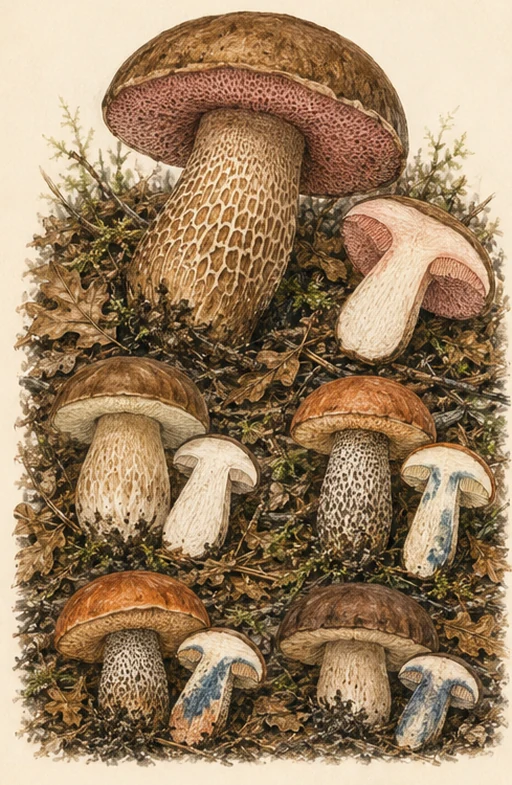
Not poisonous, but so bitter that one fruitbody makes a whole dish inedible, and cooking does not take the bitterness away.
A photograph cannot settle this pair. The two most reliable marks, the darkening of the cut flesh and the bitterness, cannot be checked from an image. The pinking tubes and the net on the stem show only in a good picture taken from below and to one side, and in young fruitbodies the tubes are still white in both species.
Check whether this one is out near you
The foraging forecast changes daily — with rainfall, temperature and the phase of the flush, rather than «it ought to be the season».
Your comment
No sign-up. A question, a correction, an observation — all welcome.
Updated from the FungRadar species reference · not a specialist's determination