
Milk White BrittlegillRussula delica
Traditionally collected in: Russia, Belarus and Poland
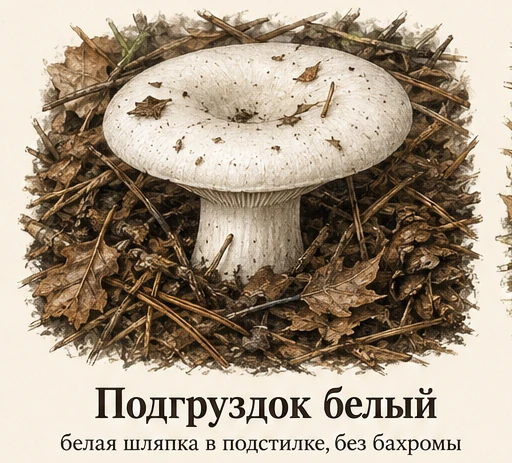
Description
A stout white to cream mushroom with a depressed or funnel-shaped cap. It often pushes up through soil and leaf litter, so the cap is commonly dirty or partly buried.
Where it grows
In broadleaved and mixed woodland, often deep in the litter layer.
Mainly in late summer and autumn after wet weather.
«Milk White Brittlegill — or something like it?»
If the description above leaves you unsure, do not guess from memory and do not compare by eye with a picture off the internet. Our photo identifier shows several likely candidates with percentages, and names the dangerous lookalikes if there are any — rather than one confident answer.
In detail
Season
Fruits from early July to early October.
What to do with it
This species may not be picked (see «Caution» below), so storing and cooking do not belong here. If you find one: photograph it where it stands, do not cut or dig it up, and remember the spot for your own records — the mycelium fruits there year after year.
Take care
Eaten in parts of Europe after cooking and often used for preserving. It does not produce latex when broken, unlike true milkcaps. The dry cap and lack of a shaggy margin are useful clues, but these features alone are not enough for a safe identification.
Nothing on this page is an expert opinion, and nothing here confirms that the mushroom you found is edible. Photo identification in this service is a probabilistic hint, not permission to pick or to eat.
Lookalikes
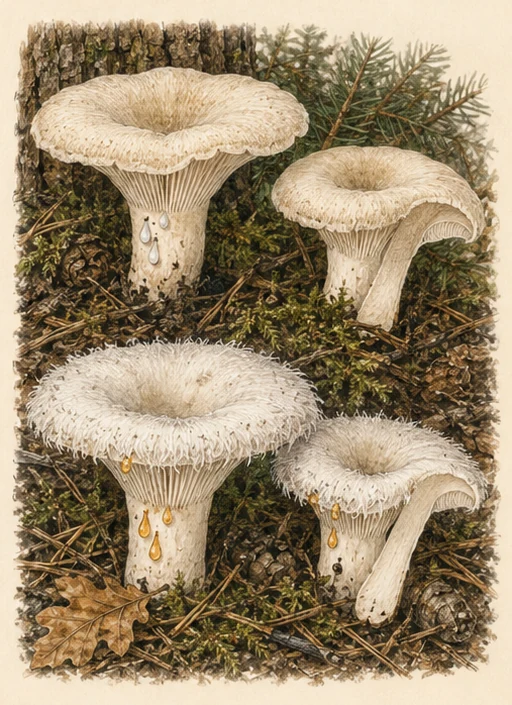
The copious milk is burning and acrid, and the mushroom is inedible fresh; it is taken only for salting after long soaking and boiling.
A photograph cannot settle this pair. The milk test decides it and there is no milk test in a picture. The felted down of the cap is easily taken for stuck-on debris in an image, and the crowding of the gills changes a great deal with age in both species.
The milk is burning and acrid; the mushroom is fit only for salting after long soaking, and a number of field guides place it among the inedible.
A photograph cannot settle this pair. What separates them is the milk test, and that is not a visual mark. Both are white and funnel-shaped with decurrent gills, and seen from above in a picture they look the same.
Edible on a par with Milk White Brittlegill; for the table there is no need to tell them apart.
- ·Look at the top of the stem where the gills meet it: the Blue Band Brittlegill shows a bluish-green band there, Milk White Brittlegill does not.
- ·The gills of the Blue Band Brittlegill are noticeably more crowded and narrower.
- ·The fruitbodies are usually smaller than those of Milk White Brittlegill.
Check whether this one is out near you
The foraging forecast changes daily — with rainfall, temperature and the phase of the flush, rather than «it ought to be the season».
Your comment
No sign-up. A question, a correction, an observation — all welcome.
Updated from the FungRadar species reference · not a specialist's determination