
Bovine BoleteSuillus bovinus
Edible only after thorough cookingTraditionally collected in: Russia, Belarus and Poland
Description
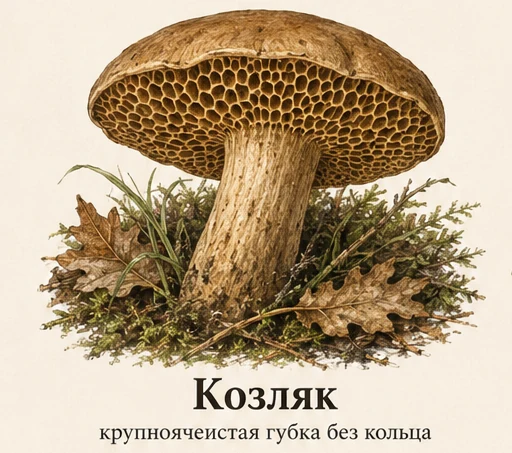
A small to medium bolete with a yellow-brown to reddish-brown cap. The pores are unusually large, angular and often irregular. The stem has no ring.
Where it grows
Closely associated with pine, especially on damp, mossy or peaty ground.
Mainly from summer into autumn, often continuing in cool, wet weather.
«Bovine Bolete — or something like it?»
If the description above leaves you unsure, do not guess from memory and do not compare by eye with a picture off the internet. Our photo identifier shows several likely candidates with percentages, and names the dangerous lookalikes if there are any — rather than one confident answer.
In detail
Season
Fruits from early July to mid October.
What to do with it
This species may not be picked (see «Caution» below), so storing and cooking do not belong here. If you find one: photograph it where it stands, do not cut or dig it up, and remember the spot for your own records — the mycelium fruits there year after year.
Take care
Edible when correctly identified and cooked. The flesh may develop pinkish tones during cooking or after bruising; this is not in itself a sign of spoilage. Avoid old, waterlogged or decaying fruitbodies.
Nothing on this page is an expert opinion, and nothing here confirms that the mushroom you found is edible. Photo identification in this service is a probabilistic hint, not permission to pick or to eat.
Lookalikes
Inedible: the flesh is burning hot with pepper, and the species carries toxins, although tiny amounts are sometimes dried as a seasoning. It is also known for taking up heavy metals strongly on contaminated ground.
- ·Colour of the pore surface: olive-brown or yellow-brown with no rusty tone in Bovine Bolete; plainly rust-coloured, reddish or rusty brown in the Peppery Bolete.
- ·Cut the bottom of the stem: in the Peppery Bolete the flesh there is sulphur or chrome yellow and the mycelium beneath it bright yellow; in Bovine Bolete the flesh is pale yellow.
- ·Shape of the pores: large, angular and lattice-like in Bovine Bolete, running noticeably down the stem; uneven in the Peppery Bolete but without that lattice.
- ·Size and manner of growth: Bovine Bolete is the larger, with a cap of three to twelve centimetres, and grows in large troops; the Peppery Bolete is small, two to six centimetres, and comes singly.
- ·Taste with the tip of the tongue and spit it out: burning hot in the Peppery Bolete, bland in Bovine Bolete.
Edible, though rated below Bovine Bolete, and, like other Suillus, hard on the digestion of some people.
- ·Cap skin: smooth and sticky in Bovine Bolete; dry and finely granular-felted, like suede, in the Velvet Bolete.
- ·Pores: large, angular and running down the stem in Bovine Bolete; small, dark olive and stopping short of the stem in the Velvet Bolete.
- ·On cutting: the flesh of the Velvet Bolete turns blue, that of Bovine Bolete does not.
Edible and rated above Bovine Bolete. Confusing the two is not dangerous, but it is worth knowing which of them is in the basket.
- ·Pores: small, round and pale yellow in the Weeping Bolete; large, angular, olive-brown and running down the stem in Bovine Bolete.
- ·Stem: the Weeping Bolete is scattered with brown granules above the tubes; the stem of Bovine Bolete is smooth.
- ·A young Weeping Bolete exudes drops of milky white liquid from the pores, which Bovine Bolete never does.
Check whether this one is out near you
The foraging forecast changes daily — with rainfall, temperature and the phase of the flush, rather than «it ought to be the season».
Your comment
No sign-up. A question, a correction, an observation — all welcome.
Updated from the FungRadar species reference · not a specialist's determination